Technological Advancements in 1.6T Optical Modules: Pushing the Limits of High-Speed Networking
The evolution of data center networking and high-performance computing has accelerated the demand for ever-higher-speed optical interconnects. As 400G and 800G optical modules become mainstream, 1.6 Terabit per second (1.6T) optical modules are emerging as the next frontier, offering unprecedented bandwidth for hyperscale data centers, AI clusters, and ultra-low latency computing environments. Achieving these speeds requires innovation across multiple domains, from modulation formats to photonics integration, thermal management, and intelligent signal optimization.
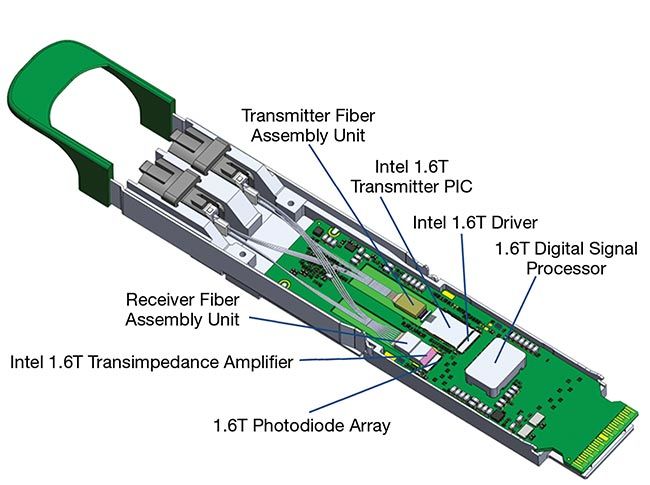
1. High-Density Multi-Lane Architecture
1.6T optical modules utilize multi-lane parallelism to achieve extraordinary aggregate throughput. Common implementations include:
- 16 lanes × 100G PAM4, or
- 32 lanes × 50G PAM4,
allowing a single module to transmit 1.6Tbps of data without increasing physical fiber count. This architecture provides:
- High port density, reducing the number of transceivers needed in hyperscale deployments.
- Low-latency performance, critical for AI inference, high-frequency trading, and HPC workloads.
- Modular scalability, enabling operators to upgrade networks efficiently without massive infrastructure changes.
2. Advanced Modulation Schemes
To achieve 1.6T speeds over existing fiber infrastructure, optical engineers rely on advanced modulation techniques:
- PAM4 (Pulse Amplitude Modulation, 4-level) remains the standard, doubling data per lane relative to traditional NRZ signaling.
- Emerging multi-level schemes, such as PAM8 or hybrid PAM4-coherent approaches, are being explored to further enhance bandwidth while maintaining signal integrity over challenging link distances.
These modulation techniques, combined with sophisticated forward error correction (FEC) algorithms, ensure reliable high-speed transmission while minimizing bit-error rates.
3. Silicon Photonics Integration
Silicon photonics (SiPh) has become a cornerstone technology for 1.6T optical modules. By integrating modulators, photodetectors, and waveguides on a silicon substrate, SiPh offers:
- Ultra-high integration density, supporting multiple lanes and wavelengths in a compact module footprint.
- Enhanced energy efficiency, critical in dense, high-speed deployments.
- Reduced manufacturing costs, leveraging mature CMOS fabrication processes for large-scale production.
SiPh also facilitates the integration of wavelength multiplexing within the module, further increasing effective throughput without expanding physical fiber infrastructure.
4. Thermal Management and Liquid Cooling
At 1.6T, thermal dissipation becomes a significant challenge. High-speed lanes generate substantial heat, and improper management can degrade signal integrity or reduce module lifetime. Recent innovations include:
- Liquid-cooled optical modules, enabling higher port densities without overheating.
- Advanced heat sink designs with low thermal resistance to maintain stable operating temperatures.
- Power-efficient transceiver designs, optimizing the trade-off between performance and thermal load.
These advances allow operators to deploy 1.6T modules in dense rack configurations without compromising reliability.
5. Intelligent Signal Processing and Digital Diagnostics
Modern 1.6T optical modules are increasingly smart. They incorporate:
- Digital signal processing (DSP) for real-time equalization and adaptive compensation of channel impairments.
- Integrated Digital Diagnostics Monitoring (DDM) for tracking optical power, temperature, and voltage.
- Programmable modules, allowing operators to tune link parameters dynamically to optimize performance across varying conditions.
This intelligence ensures consistent performance in complex, multi-tiered networks while enabling predictive maintenance.
6. Coherent and Multi-Wavelength Technologies
For longer-reach or metro applications, coherent optical technologies are being integrated into 1.6T modules. Features include:
- Single-laser multi-wavelength transmission, maximizing fiber utilization.
- Advanced modulation formats such as 16-QAM or higher for ultra-high spectral efficiency.
- Enhanced FEC and adaptive equalization, ensuring error-free transmission over tens of kilometers.
Coherent 1.6T modules are particularly suitable for backbone, metro, and AI supercomputing clusters where both bandwidth and reach are critical.
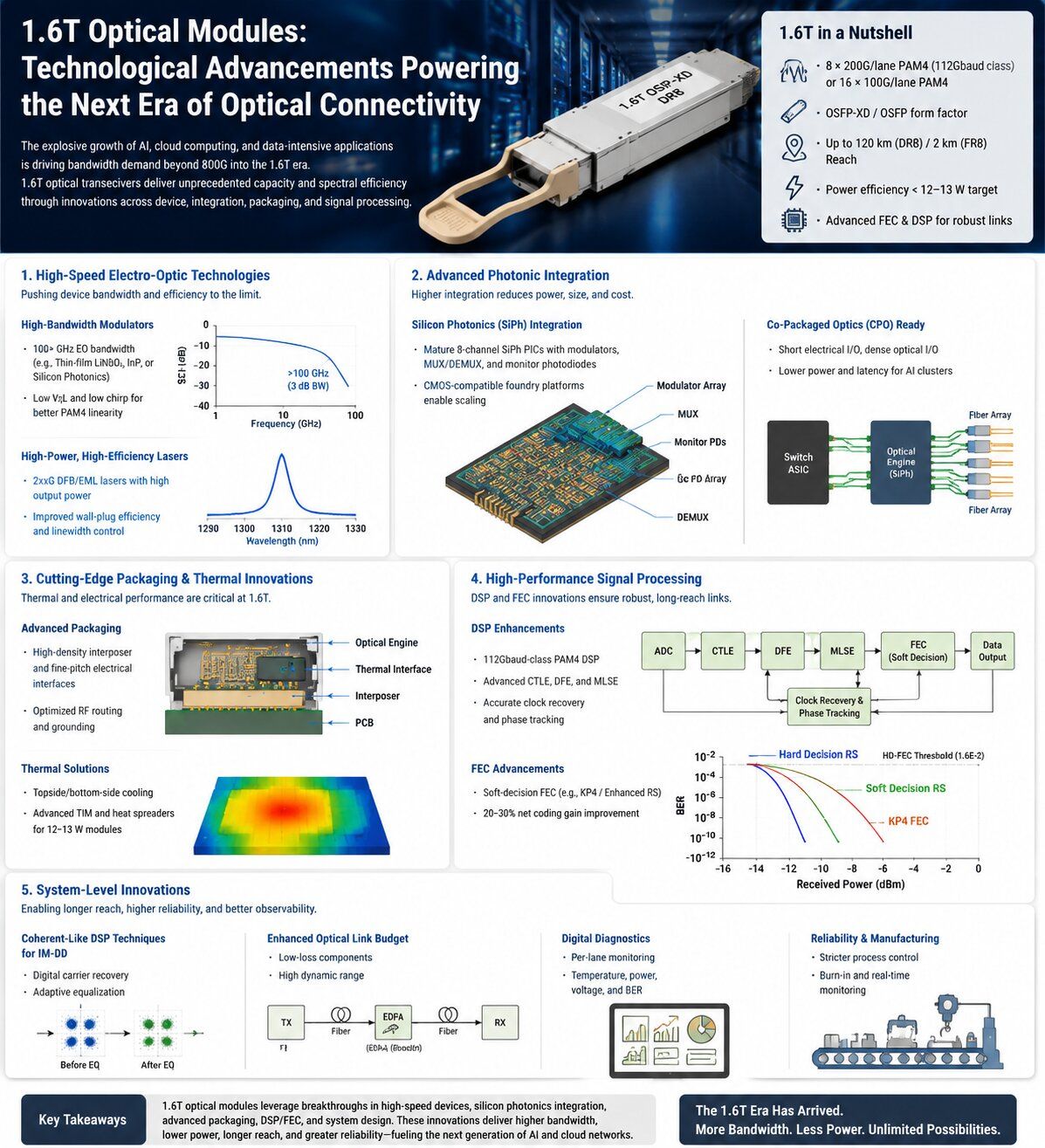
7. The Road Ahead: Towards 3.2T and Beyond
The 1.6T optical module represents the cutting edge of current interconnect technology, but research is rapidly progressing toward 3.2T and 6.4T modules. Achieving these speeds will rely on:
- Higher-order modulation techniques, including PAM8 and coherent multi-level formats.
- Advanced silicon photonics integration, supporting more lanes and wavelengths.
- Next-generation cooling and power management, essential for dense, ultra-high-speed deployments.
These advancements are setting the stage for the next era of hyperscale networking and exascale computing.
Conclusion
1.6T optical modules are redefining what is possible in high-speed optical communication. By combining multi-lane architectures, advanced modulation, silicon photonics, intelligent DSP, and innovative thermal management, these modules provide the bandwidth, reliability, and energy efficiency required for the next generation of data centers and AI workloads.
In the race toward ever-faster networks, 1.6T modules are not just a milestone—they are a gateway to the future of ultra-high-speed, intelligent networking.